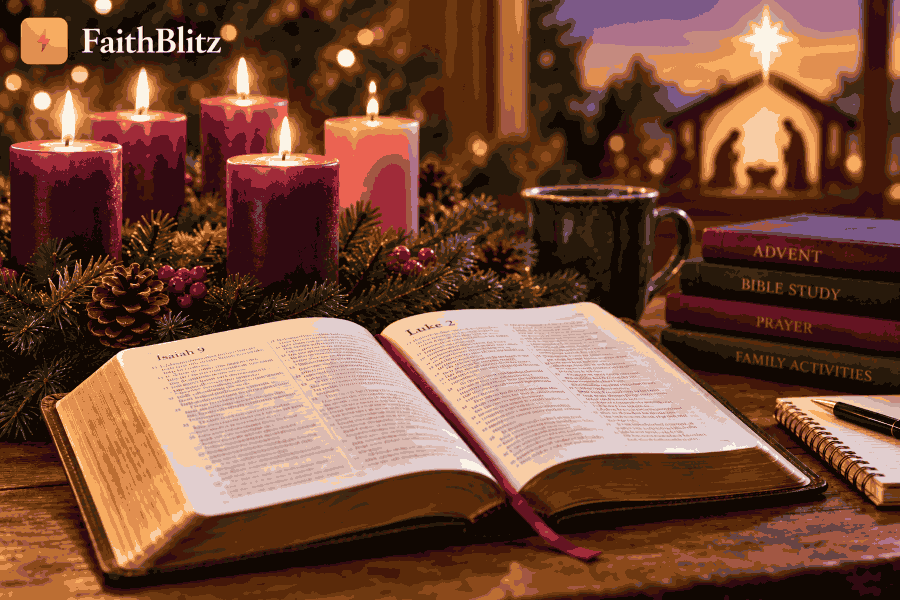
Advent Preparation — Bible Study Guide for the Season Ahead
Prepare for Advent with Scripture readings, simple study ideas, family activities, and Bible quizzes that keep the season centered on Christ.
Advent can arrive quickly. Thanksgiving ends, Christmas plans accelerate, and suddenly December feels more like a countdown than a season of reflection.
This Advent Bible study guide is designed to help families, Sunday school teachers, small groups, and individual Bible readers prepare before the Christmas rush begins. In 2026, the first Sunday of Advent falls on November 29, making late October and November a good time to choose readings, activities, and Bible study plans for the weeks ahead.
What Is Advent?
Advent is the season leading up to Christmas observed by many Christians as a time of preparation for celebrating the birth of Jesus.
The Bible does not command an Advent calendar, wreath, or four-week observance. Those are later Christian traditions. What Scripture does give us is the story Advent points toward: God’s promises, the coming of the Messiah, the birth of Jesus, and the hope found in Christ.
That distinction can make Advent especially meaningful.
The goal does not have to be completing a complicated program. It can simply be making intentional room to read Scripture and remember why the Christmas story matters.
For more seasonal Bible resources, browse the Christmas Bible topics on FaithBlitz.
Start Advent Preparation Before December
One of the easiest ways to make Advent more meaningful is to prepare before the season begins.
Choose when your household or group will meet. Decide whether you want to read Scripture daily, several times per week, or only on Sundays. Gather any printables, quizzes, discussion questions, or children’s activities before schedules become crowded.
A simple plan is often easier to maintain than an ambitious one.
You might spend ten minutes after dinner reading a passage together. A Sunday school class might devote the first part of each December lesson to one section of the Christmas story. A small group could spend each meeting studying one major theme connected with Christ’s coming.
The important part is consistency, not complexity.
Begin With the Promises of the Messiah
The Christmas story does not begin in Bethlehem.
Long before Jesus’ birth, Scripture pointed forward to God’s promised King and Savior.
Isaiah 7:14 speaks of the virgin who would conceive and give birth to a son called Immanuel. Isaiah 9:6 describes a child who would be born and a son who would be given. Micah 5:2 points to Bethlehem in connection with the coming ruler of Israel.
Reading these passages before moving into Matthew and Luke helps place Christmas within the larger biblical story.
It also gives students and families a useful question to consider:
Why were people waiting for the Messiah in the first place?
Read the Christmas Story in Sections
Instead of reading the entire Nativity account at once, Advent gives you time to slow down.
Begin with Luke 1 and the announcements surrounding the births of John the Baptist and Jesus.
Spend time with Mary’s response in Luke 1:26–38 and her song of praise in Luke 1:46–55.
Then move into Matthew 1:18–25 and Luke 2:1–20 as Christmas approaches.
Matthew 2 can follow with the visit of the Magi and the events surrounding Herod.
Reading the accounts separately makes it easier to notice details that are sometimes blended together in Christmas traditions.
For example, Luke records shepherds visiting Jesus after his birth, while Matthew records the Magi visiting Jesus in a house. Scripture also does not tell us that there were exactly three Magi.
Those details make excellent Bible study discussions and quiz questions.
Use Bible Quizzes as Advent Review
Bible quizzes can add some energy to Advent study without replacing the Scripture itself.
After reading a passage, try a short quiz to see what everyone remembers. Questions about Mary, Joseph, Bethlehem, the shepherds, angels, the Magi, and Old Testament prophecy can reveal which parts of the story are familiar and which deserve another look.
Browse the FaithBlitz Bible quiz library for Christmas and Bible knowledge activities you can use throughout the season.
For Sunday school, you can read the passage first and then play a quiz as a review activity.
For families, try a quiz after dinner and look up any questions that cause disagreement.
For individual study, quizzes can help you notice gaps in your own memory and give you a reason to return to the passage.
Keep Advent Scripture-First
Christmas traditions can be meaningful, but Advent becomes much easier to teach when Scripture stays at the center.
You do not need an elaborate devotional setup.
Read the passage.
Ask what happened.
Notice what the passage says about God, Jesus, and the people involved.
Then ask how that passage connects to the larger story of Christ’s coming.
A study of Luke 2 might focus on the angel’s announcement to the shepherds.
Matthew 1 can lead into a discussion of Joseph’s response after the angel appeared to him in a dream.
Matthew 2 provides opportunities to study the Magi, Herod, and the family’s flight to Egypt.
Each passage already contains enough material for meaningful discussion.
Advent Ideas for Families
Family Advent does not need to resemble a formal church service.
Choose one short passage and read it together. Let children ask questions. Use a Bible quiz or printable activity afterward if it helps keep younger learners involved.
You can also revisit the same passage several times.
Children often benefit more from becoming familiar with a smaller number of important passages than from rushing through a different reading every day.
Consider keeping the Bible open during the activity so children learn that the answers come from Scripture rather than simply from memory.
Advent Ideas for Sunday School Teachers
Teachers can use Advent as a four-week mini-series leading toward Christmas.
One week might focus on promises about the Messiah.
Another can cover Gabriel’s announcement to Mary.
A third can study Jesus’ birth and the shepherds.
The final lesson can focus on what the birth of Jesus means within the larger biblical story.
Quizzes, discussion questions, word searches, and other activities can reinforce those lessons without requiring an entirely separate curriculum.
The FaithBlitz Christmas topic collection is a useful starting point when planning those weeks.
Advent Ideas for Bible Study Groups
Adult Bible study groups can go deeper than simply retelling the Nativity story.
Compare Matthew and Luke.
Trace Old Testament passages quoted in the birth narratives.
Study the songs and responses found in Luke 1 and 2.
Look carefully at what Scripture actually says versus details people sometimes assume from Christmas art, songs, or tradition.
That approach can turn a familiar story into a surprisingly rich study.
It also works well for church groups that want a Bible study game or quiz at the end of a meeting.
Make Room for Reflection
Advent preparation is not only about gathering resources.
It is also about leaving enough room to pay attention.
A packed December calendar can make even good activities feel rushed. It is perfectly fine to choose fewer readings and spend more time with them.
Consider ending each study with one simple question:
What does this passage help us understand about Jesus?
That question works with prophecy, the angelic announcements, Mary’s response, Joseph’s obedience, the shepherds, and the Magi.
It keeps the focus where the Christmas story itself places it.
Prepare for Advent With FaithBlitz
If you are planning Sunday school lessons, family Bible time, a church gathering, or your own seasonal study, preparing early gives you more room to enjoy the weeks leading to Christmas.
Start with Scripture. Add quizzes and activities where they genuinely help. Keep the schedule manageable, and allow familiar passages to become familiar for a reason: because you return to them again and again.
Explore more Bible study articles on the FaithBlitz blog, browse Bible quizzes, or visit the Christmas Bible collection as you build your Advent plan.
Prepare for Advent: choose your first Scripture passage now, then use FaithBlitz throughout the season for Bible quizzes, study activities, and Christmas-themed learning.