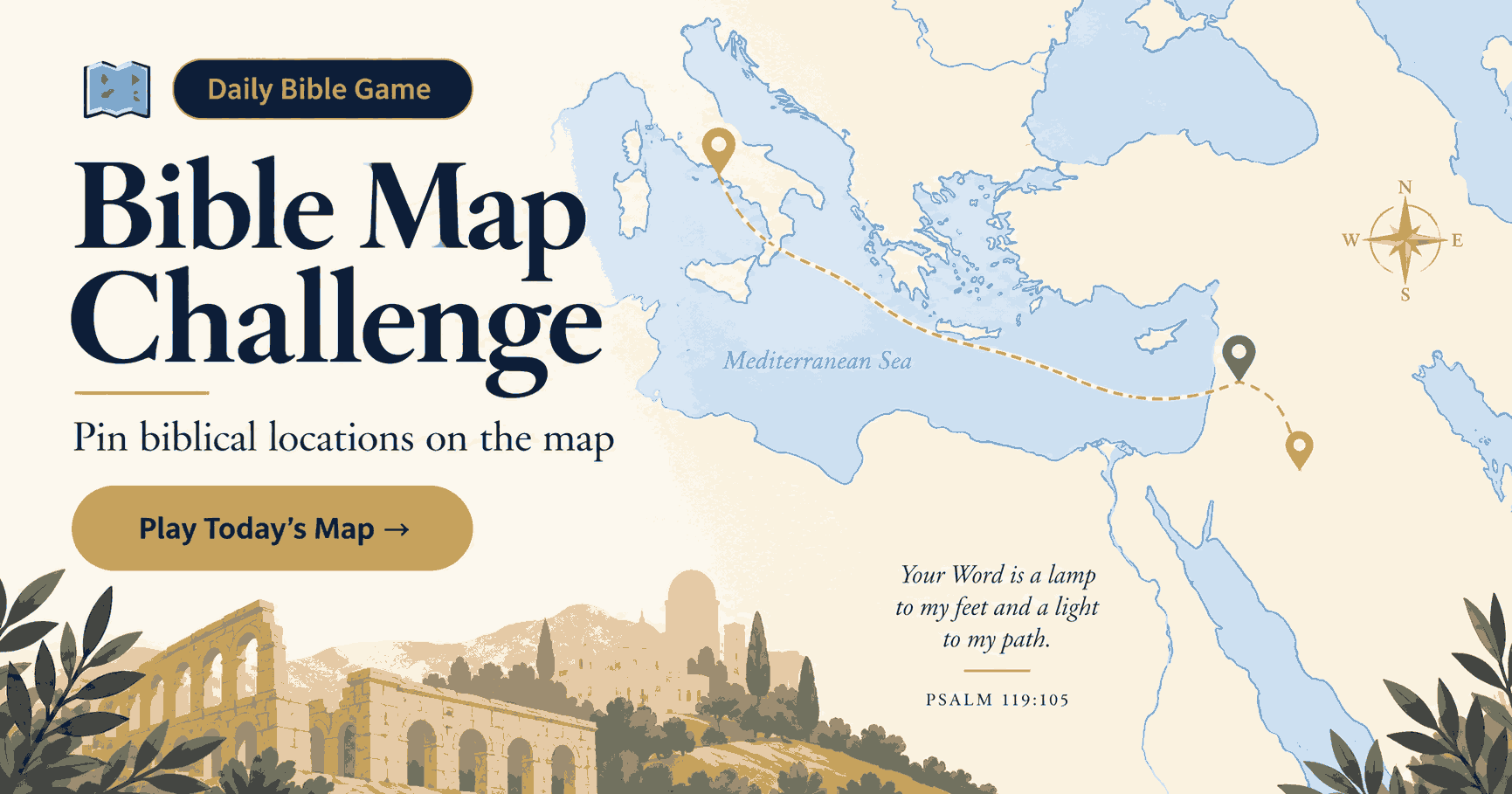
Bible Geography Game: Play the Bible Map Challenge
Test your knowledge of biblical locations with the free Bible Map Challenge. Pin five places each day, learn from every guess, and build a stronger mental map of Scripture.
Bible stories did not happen in abstract places.
They unfolded in cities, villages, deserts, mountains, coastlines, and empires that shaped how people traveled, where events happened, and how different parts of Scripture connect.
Jerusalem sits in a very different setting from Capernaum. Ephesus belongs to a very different world from Babylon. Paul's missionary journeys become easier to follow when you can picture the routes across the Eastern Mediterranean.
That is why Bible geography matters.
The Bible Map Challenge on FaithBlitz is a free daily Bible geography game designed to help you connect Scripture with the places where biblical events happened.
Each day, you get five locations to identify on an interactive map.
Sometimes the game gives you a place name and asks you to find it. Other times, it gives you a biblical event and asks you to identify where it happened.
The closer your pin is to the correct location, the more points you earn.
And after every guess, you learn something.
What Is the Bible Map Challenge?
Bible Map Challenge is a daily Bible map quiz built around biblical locations.
Instead of choosing from four multiple-choice answers, you interact directly with a map.
Each daily challenge contains five rounds.
For every round, you read the prompt, study the map, and place your pin where you believe the biblical location belongs.
You can earn up to 100 points per round, for a maximum daily score of 500 points.
Your score is based on how close your guess is to the true location.
But the game is not only about getting a high score.
After every guess, FaithBlitz shows you:
- ·The correct location
- ·Your distance from the answer in miles
- ·A short educational explanation
- ·The relevant Scripture reference
That means even a wrong answer can help you learn Bible geography for the next time you see that place.
How to Play the Bible Geography Game
Playing Bible Map Challenge is simple.
You do not need to create an account before starting.
Open the game, begin the daily challenge, and work through the five rounds.
1. Read the Prompt
Every round uses one of two question types.
Find This Place
You are given the name of a biblical location and asked to place it on the map.
For example, you might be asked to find Jerusalem, Capernaum, Ephesus, or Babylon.
Your challenge is to remember where that location belongs geographically.
Where Did This Happen?
Instead of giving you the city name, the game describes a biblical event.
You then need to determine where the event happened and place your pin on that location.
This adds another layer to the challenge because you first need to remember the biblical story and then connect that event to its geography.
2. Place Your Pin
Once you have an answer in mind, click or tap the map.
Your pin marks your guess.
Depending on the question, you might be looking at a close regional map or a much larger section of the biblical world.
3. See How Close You Were
After submitting your guess, the game reveals the correct location.
You will see how far your pin was from the answer and receive a score of up to 100 points.
A very accurate guess earns a high score. A guess farther away earns fewer points.
4. Learn From the Explanation
Each answer includes context about the biblical location along with a Scripture reference.
This is one of the most useful parts of the game.
Instead of simply telling you whether you were right or wrong, Bible Map Challenge gives you a reason to remember the location.
Over time, places that once felt like unfamiliar names can start forming a mental map of the Bible.
Four Map Regions Cover the Biblical World
The Bible spans a surprisingly large geographic area.
That is why Bible Map Challenge does not use a single map for every question.
The game includes four geographic regions.
Galilee & Judea
This closer view is especially useful for locations connected with the life and ministry of Jesus.
You may encounter places around Jerusalem, Judea, Galilee, and the Sea of Galilee.
Understanding where locations such as Capernaum and Jerusalem sit relative to one another can make the Gospel narratives easier to visualize.
Israel & the Levant
This map expands the view to include the wider land of Israel and surrounding areas.
It helps put many Old Testament stories, neighboring peoples, kingdoms, and travel routes into perspective.
The Eastern Mediterranean
The Eastern Mediterranean becomes especially important when reading Acts and the New Testament letters.
Paul's missionary journeys crossed cities, islands, provinces, and coastlines throughout this region.
Seeing these places on a map can make Paul's travels feel less like a list of unfamiliar names and more like an actual journey from one community to another.
The Full Biblical World
The largest map stretches from Rome to Babylon.
It gives the game room to explore locations across the broader biblical world rather than limiting questions to the land of Israel.
One day's challenge might keep you close to Jerusalem while another could take you across the Mediterranean or toward Mesopotamia.
What Can You Learn From a Bible Map Quiz?
A good Bible geography quiz should do more than test whether you recognize a place name.
It should help you understand how locations connect to the biblical story.
Bible Map Challenge is designed around that idea.
The Geography of Jesus' Ministry
Many familiar Gospel stories happened within a relatively compact region.
Places such as Jerusalem, Capernaum, Galilee, and Judea appear repeatedly.
Learning where these places are can help you better visualize the movement of Jesus and His disciples throughout the Gospel accounts.
Paul's Missionary Journeys
Acts contains constant movement.
Paul travels between cities and regions across the Roman world, establishing churches, preaching, facing opposition, and returning to communities he had previously visited.
A map makes those journeys easier to follow.
Places such as Ephesus become more memorable when you can picture where they were located in relation to the Mediterranean and the other cities Paul visited.
The Seven Churches of Revelation
Revelation opens with messages to the Seven Churches of Revelation in Asia Minor.
Those churches were real communities in real locations.
Seeing them geographically can add another layer of context when reading the opening chapters of Revelation.
Old Testament Cities and Empires
Bible geography extends far beyond New Testament locations.
Babylon, for example, carries enormous importance in the Old Testament story.
Locating Babylon on a map helps put events such as the exile into geographic perspective and shows how far parts of the biblical story extend beyond Jerusalem.
Why Learning Bible Geography Helps
It is possible to know a Bible story well without knowing exactly where it happened.
But geography often adds context.
When you begin to recognize biblical locations, Scripture can become easier to visualize.
You start noticing questions such as:
- ·How far did someone travel?
- ·Which regions bordered one another?
- ·Was a city near the coast or inland?
- ·How did an empire relate geographically to Israel?
- ·Why did certain cities become important centers for the early church?
A Bible geography game cannot answer every historical or theological question, but it can help build the mental framework that makes those questions easier to understand.
That is what makes repeated play valuable.
You are not simply memorizing dots on a map.
You are connecting places with people, events, journeys, and Scripture.
Tips for Improving Your Bible Map Score
Your first few rounds may be harder than expected.
That is normal.
Biblical locations can be difficult to remember until you start seeing them repeatedly.
Start With Major Landmarks
Learn the locations you see often.
Jerusalem is an obvious starting point.
Then begin placing other locations relative to places you already know.
For example, once you know the general location of the Sea of Galilee, nearby Gospel locations become easier to place.
Think in Regions Before Cities
You do not always need to know the exact location immediately.
First ask yourself which general region the place belongs to.
Is it in Galilee?
Judea?
Asia Minor?
Mesopotamia?
Italy?
Getting the region right can dramatically improve your guess even if you cannot pinpoint the city perfectly.
Connect Places to Stories
Instead of memorizing a location by itself, connect it to a biblical event.
A place tied to a memorable story is easier to recall than an isolated point on a map.
That is especially useful for the "Where did this happen?" questions.
Learn From Wrong Answers
Do not waste a missed question.
Look at the correct location.
Read the explanation.
Check the Scripture reference.
Then compare the answer with where you placed your pin.
That small review can make the location much easier to remember the next time it appears.
Part of the FaithBlitz Daily Set
Bible Map Challenge is part of the FaithBlitz Daily Set.
The Daily Set brings FaithBlitz's daily Bible games together so you can complete a fresh collection of Scripture challenges.
That means the Bible Map Challenge can become one part of a larger daily Bible learning routine.
You might test your geography, then move to another game focused on Bible characters, verses, events, or other areas of Scripture knowledge.
Completing all of the daily games earns bonus XP.
You do not need an account to play Bible Map Challenge.
If you create a free FaithBlitz account, your progress, XP, and streaks can be saved.
Registered players can also compete on seasonal FaithBlitz leaderboards with real prizes.
Whether you play casually or compete, the Bible Map Challenge itself remains free.
More Ways to Test Your Bible Knowledge
Bible geography is only one part of Scripture knowledge.
FaithBlitz also includes hundreds of Bible quizzes covering books, chapters, people, events, teachings, and topics throughout Scripture.
If a location in Bible Map Challenge reminds you of a story you want to review, you can explore related quizzes and test what you remember.
Play the Bible Map Challenge
How well do you really know the map of the Bible?
Can you find Jerusalem without a label?
Do you know where Capernaum sits?
Could you place Ephesus?
What about Babylon?
And if you were shown a biblical event instead of a city name, could you identify where it happened?
There is one good way to find out.
You get five locations every day and up to 500 points to earn.
Place your pins, learn from every answer, and see how quickly the biblical world starts becoming more familiar.
Bible Map Challenge FAQ
Is Bible Map Challenge free?
Yes. Bible Map Challenge is a free Bible geography game on FaithBlitz. You can play the daily five-round challenge without paying.
Do I need to create an account?
No. You can play Bible Map Challenge without signing up. A free FaithBlitz account allows your progress, XP, and streaks to be saved and lets you participate in seasonal leaderboards.
How is the Bible Map Challenge score calculated?
Each round is worth up to 100 points. Your score is based on the distance between your pin and the correct biblical location. With five rounds per daily challenge, the maximum score is 500 points.
What regions do the maps cover?
Bible Map Challenge uses four regions: Galilee & Judea, Israel & the Levant, the Eastern Mediterranean, and the full Biblical World stretching from Rome to Babylon.