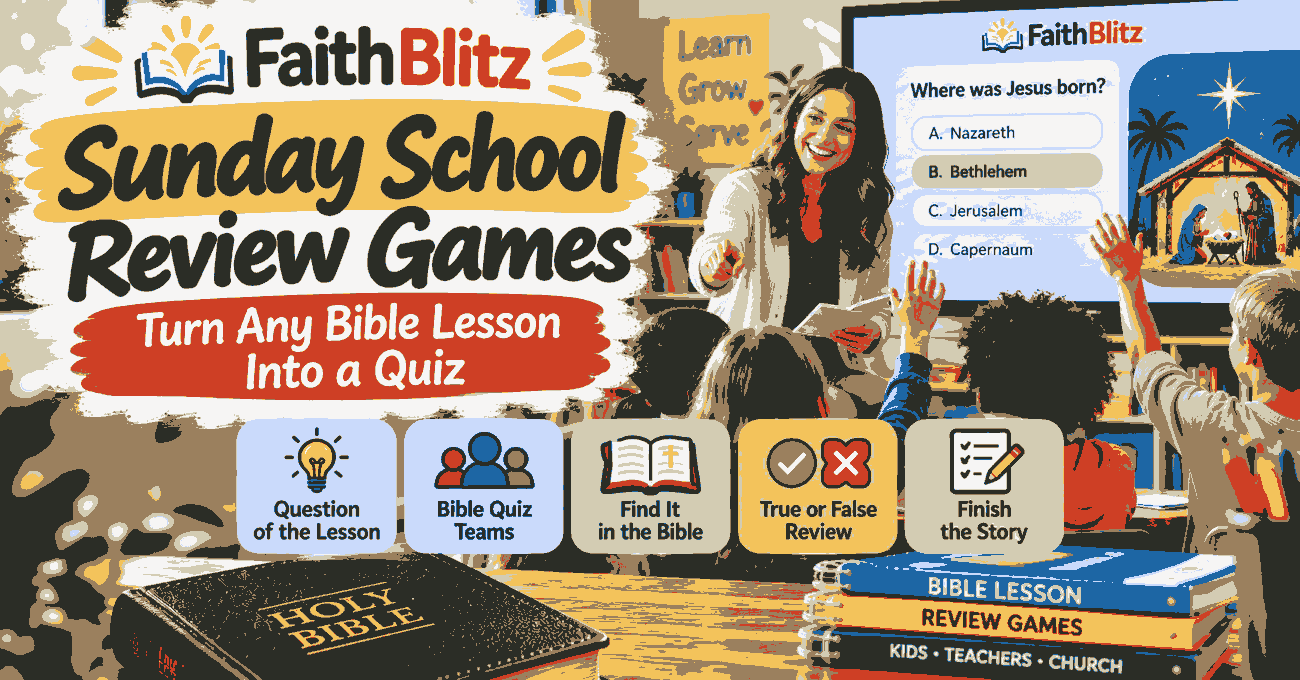
Sunday School Review Games — Turn Any Bible Lesson Into a Quiz
Turn any Bible lesson into a Sunday school review game with reusable quiz formats, team activities, teacher tips, and ready-to-use FaithBlitz resources.
A Sunday school lesson does not have to end when the teaching is finished.
A short review game can help students remember the people, places, events, verses, and ideas they just learned.
It can also show a teacher which parts of the lesson students understood and which parts may need another explanation.
The best Sunday school review games do not require complicated supplies or hours of preparation.
You can take almost any Bible lesson and turn it into a simple quiz, team challenge, Scripture search, or class competition.
FaithBlitz gives teachers another option by providing ready-to-use Bible quizzes, games, printables, and review activities that can be used alongside a weekly lesson.
If you are new to using FaithBlitz in a classroom, start with our complete guide to using FaithBlitz for Sunday school.
Why Use Review Games in Sunday School?
Review games give students another opportunity to interact with the lesson before they leave class.
A child may hear a Bible story during the lesson but remember it more clearly after answering a question about it.
Another student may recognize a character's name but need help remembering why that person mattered.
A team game can reveal those gaps naturally.
Review activities can also make the final part of class feel purposeful.
Instead of simply asking, “Does anyone have any questions?” a teacher can use a short game to revisit the most important parts of the lesson.
The goal is not to turn every Bible lesson into a competition.
The goal is to give students another reason to think about Scripture.
Turn This Week's Bible Lesson Into a Quiz
Almost any lesson can become a quiz.
Start by identifying the most important facts, events, people, or teachings from the passage.
If you taught David and Goliath, your questions might focus on David, Goliath, Saul, the Philistines, David's response, and the outcome of the battle.
If you taught one of Jesus' parables, ask about the characters in the story, what happened, and the lesson Jesus was teaching.
If the class studied a chapter such as Luke 2, you can ask questions directly from the passage.
You do not need twenty questions.
Even five strong questions can create an effective review activity.
FaithBlitz already has quizzes covering Bible books, chapters, people, events, teachings, and major themes.
Teachers can browse the FaithBlitz Bible quiz library and choose a quiz that matches the week's lesson.
Review Game Format 1: Question of the Lesson
This is the simplest Bible review game.
Choose one important question from the lesson and ask every student to answer it before class ends.
The question should focus on something you genuinely want students to remember.
After a lesson about Noah, you might ask why Noah built the ark.
After a lesson about Moses, you might ask what happened at the burning bush.
After a lesson about Jesus calming the storm, you might ask what the disciples learned about Jesus.
Students can answer aloud, write their answer down, or discuss it with a partner.
For younger children, you can give several answer choices.
For older students, ask them to explain the answer in their own words.
This format works well when time is short because it can take only a few minutes.
Review Game Format 2: Bible Quiz Teams
Divide the class into two or more teams.
Ask one Bible question at a time.
Give each team a short opportunity to discuss the answer before responding.
A correct answer earns a point.
After revealing the answer, connect it back to the lesson.
That final step matters.
Do not simply move from question to question.
Explain why the answer is important or ask the class to find the supporting verse.
This keeps the activity focused on Bible learning rather than just scoring points.
FaithBlitz quizzes can make this easier because the questions and answers are already prepared.
Open the quiz that matches your lesson and use the questions as your classroom review.
Review Game Format 3: Find It in the Bible
Instead of asking students only to remember an answer, ask them to locate it in Scripture.
Read a question aloud.
Let students search the passage.
The first student or team to find the supporting verse can read it to the class.
This works especially well for older elementary students, youth groups, and Bible study classes that are learning how to navigate Scripture.
It also changes the emphasis of the game.
Students are not rewarded only for already knowing the answer.
They are learning how to find answers in the Bible.
You can make the activity easier by telling younger students which book or chapter to use.
For more experienced students, give only the question and let them decide where to look.
Review Game Format 4: True or False Bible Review
True-or-false questions are fast, easy to understand, and useful for checking common misunderstandings.
Suppose the lesson is about Daniel in the lions' den.
You might give students a statement about who placed Daniel in danger, why he was punished, or what happened during the night.
Students decide whether the statement is true or false.
Then read the relevant part of the passage together.
This format is especially useful when a Bible story contains details that are often remembered incorrectly.
Christmas lessons are a good example.
Many students assume the Bible says exactly three wise men visited Jesus because three gifts are named.
A true-or-false question gives the teacher an opportunity to return to Matthew 2 and examine what the passage actually says.
The review becomes a reason to read Scripture more carefully.
Review Game Format 5: Finish the Story
This format works well with narrative Bible lessons.
Retell part of the story and stop before an important event.
Ask the class what happens next.
For example, you might describe David approaching Goliath and stop before the confrontation.
You might describe Jonah being thrown into the sea and ask what happens next.
You might describe Paul and Silas in prison and stop before the earthquake.
Students can answer individually or in teams.
After they respond, continue reading the Bible passage.
This activity helps students think about the sequence of events rather than memorizing isolated facts.
It also works naturally with Bible timeline lessons.
Use Review Games With Younger Kids
Younger children usually do better when review questions are short and concrete.
Ask about names, places, actions, and major events.
Who built the ark?
Where was Jesus born?
Who fought Goliath?
What happened when Jonah was thrown into the sea?
As children become more comfortable with the story, move into simple meaning questions.
Why did Noah obey God?
Why was David willing to face Goliath?
Why did the shepherds go to Bethlehem?
Pictures, gestures, and answer choices can also help younger students participate.
The goal should be confidence and recall before moving into more difficult interpretation.
FaithBlitz also offers beginner-friendly learning paths that can give newer students a structured starting point.
Use Review Games With Older Students
Older students can handle questions that require more than simple recall.
Ask them to compare characters.
Ask why an event matters.
Ask which verse supports an answer.
Ask what changed between the beginning and end of the passage.
A lesson about Peter could include questions about what he said, what he did, and how his actions changed later.
A lesson about Paul could connect an event in Acts with one of his letters.
Older students can also create questions for one another.
Give each student a passage and ask them to write one fair quiz question from it.
Then let the class answer the questions.
Writing a good question requires students to understand the passage well enough to identify what matters.
Make the Bible the Final Authority
Review games should lead students back to Scripture.
If students disagree about an answer, that is often a useful moment.
Instead of immediately telling them who is correct, open the passage.
Read it together.
Ask students what the text actually says.
This habit helps children understand that the answer is not correct simply because the teacher says so.
The Bible itself is the source they are learning to examine.
A good review game creates more opportunities to open Scripture, not fewer.
Keep the Game Short
A review game does not need to fill the entire class period.
Five or ten minutes can be enough.
A short review at the end of every lesson can become part of the weekly routine.
Students know that after the lesson they will have a chance to test what they remember.
Teachers gain a quick way to see what stuck.
If students struggle with several questions, that may tell you what needs to be revisited next week.
If they answer confidently, you can move forward.
Reuse the Same Formats Every Week
Teachers do not need to invent a completely new game every Sunday.
That creates more preparation work than necessary.
Instead, reuse a small set of formats.
One week might end with a team quiz.
The next could use Find It in the Bible.
Another week could use True or False.
The following week might use Finish the Story.
Students quickly learn the rules because the formats are familiar.
The only thing that changes is the Bible lesson.
That makes review games sustainable instead of becoming another weekly project for the teacher.
Use FaithBlitz as a Weekly Sunday School Tool
FaithBlitz can help reduce the amount of review material a teacher has to create from scratch.
After choosing the week's Bible passage or topic, search the quiz library for a related quiz.
Teachers can use individual questions during class, let students play a quiz online, or use printable resources when a paper activity works better.
You can also browse FaithBlitz Guides for lesson ideas, Bible topics, printables, and classroom resources.
The important part is consistency.
If students become accustomed to a short Bible review every week, FaithBlitz can become one part of the normal lesson routine rather than a special activity used only occasionally.
Turn Review Into a Class Challenge
Students often enjoy seeing whether the class can improve together.
Instead of having students compete against one another, give the entire class a shared goal.
For example, ask ten questions and challenge the group to answer eight correctly.
The following week, try to beat the previous score.
This creates excitement without requiring one student or team to lose.
You can also give the class one difficult final question.
Let everyone discuss it.
Then open the Bible and verify the answer together.
This works particularly well when you want the activity to feel cooperative.
Use Review Games Before a New Lesson
Review does not always have to happen at the end of class.
A quick game at the beginning of the next lesson can reconnect students with what they learned the previous week.
Ask three questions from last Sunday's lesson.
Then transition into the new passage.
This is particularly useful when lessons are part of a series.
If the class is studying Genesis, the life of Moses, the kings of Israel, the Gospel of Matthew, or Acts, each week's story connects with what came before it.
A short review helps students see those connections.
Use Review Games for Substitute Teachers
Prepared quiz resources can also help when someone else needs to teach the class.
A substitute teacher may not have time to create an activity from scratch.
Giving them a Bible passage, a related FaithBlitz quiz, and a few discussion questions provides a simple lesson framework.
They can read the passage.
Discuss the main events.
Use the quiz for review.
Then return to Scripture for any questions students missed.
This gives the substitute something structured to work with while keeping the class focused on the Bible.
Printable Bible Review Activities
Some classrooms work better with paper.
Students may not have individual devices, internet access may be limited, or the teacher may simply want fewer screens during the lesson.
In those situations, printable quizzes can become review worksheets, team answer sheets, take-home activities, or lesson recaps.
FaithBlitz provides printable Bible resources through its quiz and printable sections.
Teachers who regularly prepare lessons can also use FaithBlitz Pro for expanded printable access and teacher-focused features.
The goal is not to add more worksheets.
It is to make it easier to turn material you are already teaching into a reusable review activity.
Sunday School Review Games Without Extra Preparation
The easiest review system is one you can repeat.
Teach the Bible lesson.
Choose several important questions.
Let students answer.
Return to Scripture.
Discuss what they missed.
That simple process can work with almost any Bible story, chapter, person, or topic.
FaithBlitz can shorten the preparation step by giving teachers an existing library of Bible quizzes and learning resources to draw from.
Start with the lesson you are already teaching.
Then find the quiz that matches it.
Sunday School Review Games FAQ
What are good Sunday school review games?
Good Sunday school review games include team Bible quizzes, Scripture searches, true-or-false questions, finish-the-story activities, and short end-of-lesson questions. The best format depends on the age of the students and the Bible passage being taught.
How long should a Sunday school review game take?
A review game can be effective in as little as five to ten minutes. The goal is to revisit the most important parts of the lesson without taking over the entire class period.
Can I turn any Bible lesson into a quiz?
Yes. Identify the main people, places, events, teachings, or verses from the lesson and turn them into questions. Even a five-question quiz can provide useful review.
Are Bible review games good for younger children?
Yes. Younger children usually do best with short questions about names, places, actions, and major events. Answer choices and visual clues can make the activity easier.
How can I make Bible review games more educational?
After each answer, return to the Bible passage. Ask students to find the supporting verse or explain why the answer matters. This turns the activity from simple trivia into Scripture review.
Can FaithBlitz be used for Sunday school?
Yes. Teachers can use FaithBlitz quizzes, games, learning paths, guides, and printable resources as part of weekly Bible lessons. Start with our Sunday school teacher guide for a broader walkthrough.
Turn This Week's Lesson Into a Quiz
You do not need a complicated game plan.
Take the Bible lesson you are already teaching.
Choose the most important ideas.
Turn them into questions.
Let students answer, discuss, and then verify those answers in Scripture.
That is enough to turn an ordinary lesson review into an active Bible-learning experience.
FaithBlitz can help with the preparation by giving you ready-to-use quizzes covering Bible books, chapters, people, stories, and topics.